
Spain's new anti-smoking law: what changes and why now is the time to quit
On 21 July 2026 the Spanish Cabinet approved the draft of the new anti-smoking law. Here's what changes, how it affects your health insurance and ten real tips to quit smoking, with my own experience.
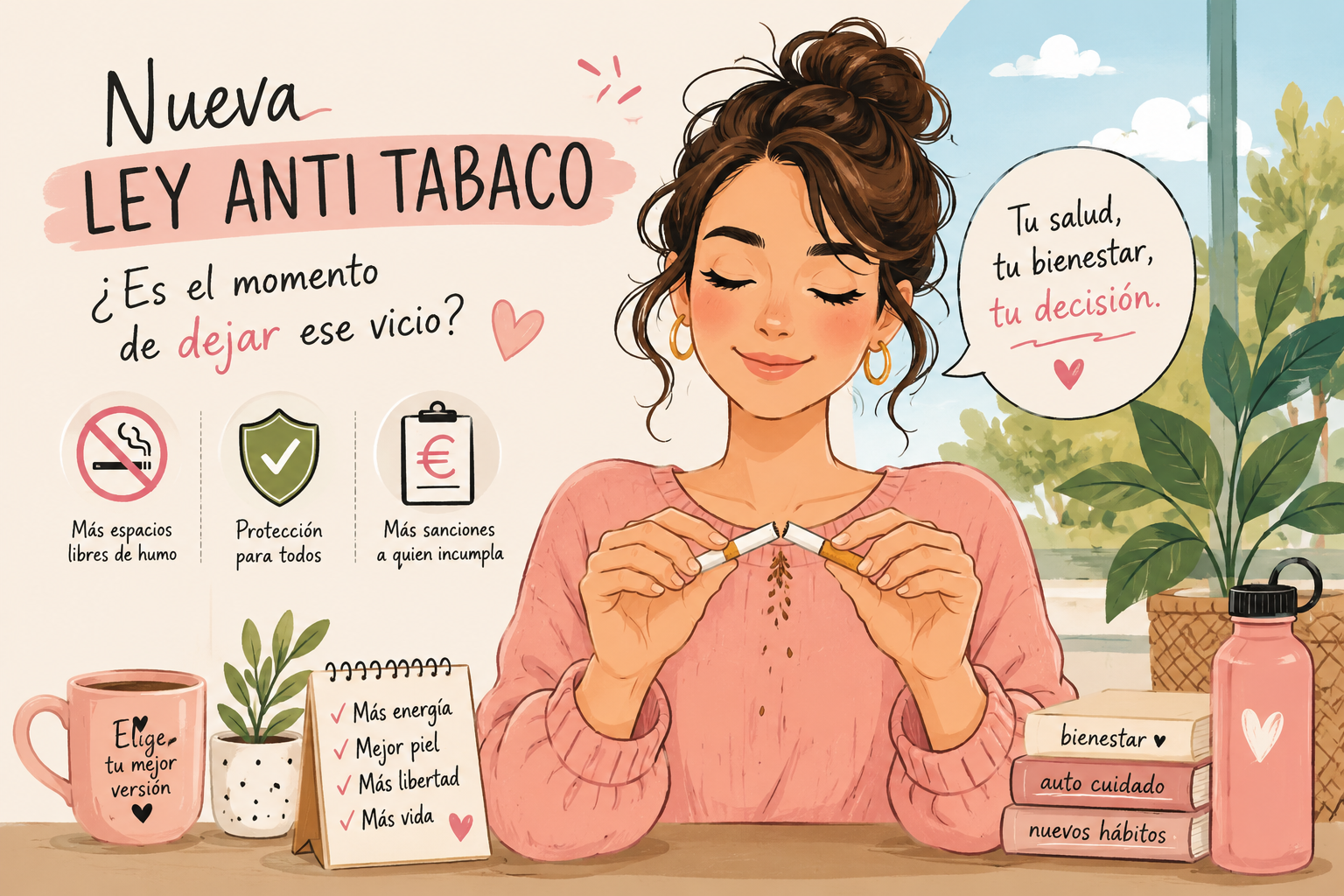
On 21 July 2026 the Spanish Cabinet approved the draft of the new anti-smoking law. It's not in force yet — it now starts its passage through Congress and the Senate. But we already know where Spain is heading in the coming months. And if you smoke, this is a good moment to understand what will change and, above all, to consider whether you want to keep being part of that story.
What the new law says
The reform vastly expands smoke-free spaces in Spain. The main changes are:
- Bar and restaurant terraces, without the current exceptions.
- Sea and river beaches.
- Communal swimming pools, indoor and outdoor.
- Sports facilities and public entertainment venues, including outdoor concerts, cinemas and theatres.
- Parks, children's play areas and national parks.
- Bus stops, shelters, stations and public transport platforms.
- Outdoor areas of hospitals, schools and universities.
- Chauffeured transport vehicles.
The law also treats e-cigarettes and vapes the same as traditional tobacco. Their sale will be restricted to specialist shops, they will be banned for anyone under eighteen and advertising restrictions will be tightened, including online.
When it comes into force
Not yet. The bill still has to go through Congress and the Senate, where it may be amended, and be published in the BOE (official gazette). Once published, it is scheduled to come into force twenty days later, with an additional two months for affected venues to update their signage.
Why this matters for your health insurance
When you take out private health insurance, one of the questions in the health questionnaire is whether you smoke. It's not to judge you: smoking multiplies the risk of heart attack, respiratory problems and other conditions. Quitting doesn't just improve your health — it also improves your risk profile for future policies and coverage upgrades.
My own experience quitting
Quitting smoking was really hard for me. But at some point I understood that it didn't bring me any benefit, and that the benefits of quitting far outweighed those of holding on to a habit that gave me nothing positive. As a make-up artist I see it all the time in my clients: when a woman quits smoking, you can see it in her skin, her energy, everything.
Before the list of tips, a question for you — the same one I asked myself. Are you really smoking because you can't quit, or because it's a cultural habit so ingrained you don't even question it? Have you ever asked yourself what you smoke for, or whether the cigarette actually solves anything?
Ten tips that really work for quitting smoking
1. Pick your D-day without noticing. How? Try not to put pressure on yourself with a fixed «I quit on this day». Start slowly, pushing back the first cigarette of the day. If you have a coffee with a cigarette in the morning, delay it a bit more each day until, without noticing, you no longer need it in the morning.
2. Write down your reasons. Make one list with the reasons you smoke and another with the reasons you should quit. Include everything from health to money. The more reasons, the more motivation.
3. Calculate what you spend. Add up how much you spend on tobacco each month and think about what you could do with that money to improve your day-to-day: hair salon, clothes, savings. It's a very concrete motivator.
4. Clean up your environment. Get rid of lighters, hide them or throw them away. And if you smoke pre-made packs, switch to rolling tobacco: having to roll each cigarette makes you realise whether you actually want it.
5. Move. Anything that raises your heart rate — brisk walking, dancing, exercising — reduces the urge to smoke and can even make you slightly reject the taste of tobacco.
6. Find company. Look for someone around you who also wants to quit — a friend, a sister, your mother — and go through the process together. Motivating each other helps a lot.
7. Ask for professional help if you need it. There are medically supervised treatments, such as nicotine replacement therapy or specific medication, that significantly increase success rates compared to going it alone.
8. Identify your triggers. Coffee, stress, going out. Spotting when you smoke most helps you anticipate.
9. Change your activities and environment. If certain plans or routines push you to smoke, it's probably time to change them. Like it or not, doing the same things leads us to choose the same things.
10. Be patient with yourself. A relapse doesn't mean you've failed. Most people who succeed tried more than once.
The benefits, week by week
- After 12 hours: blood oxygen levels start returning to normal.
- After 24-48 hours: smell and taste improve, and the risk of heart attack drops.
- After 2-5 weeks: smell and taste fully recover.
- After the first month: circulation improves, energy and physical stamina go up.
- After a few months: skin recovers elasticity and glow, and exercising feels easier.
- After a year: the risk of heart disease drops significantly compared to when you smoked.
If you're in that process
Quitting smoking isn't a straight road, and you don't have to walk it alone. If you're thinking about it, if you've already started or if you simply recognised yourself in something in this article, tell me. Message me on Instagram or Facebook — I'd love to know where you're at and what's hardest for you.
And if you feel like it, tell me too: why did you start smoking? Was it your own choice, a group of friends, something inherited from your parents? Sometimes putting the «why» into words is the first step to finding the «what for» to quit.